
Finance hub
How your money is managed.
Payments, ledger, treasury and funding pools — the same discipline a bank runs on, with every control enforced in software and proven by automated tests.
The foundation
The ledger — every cent, recorded twice
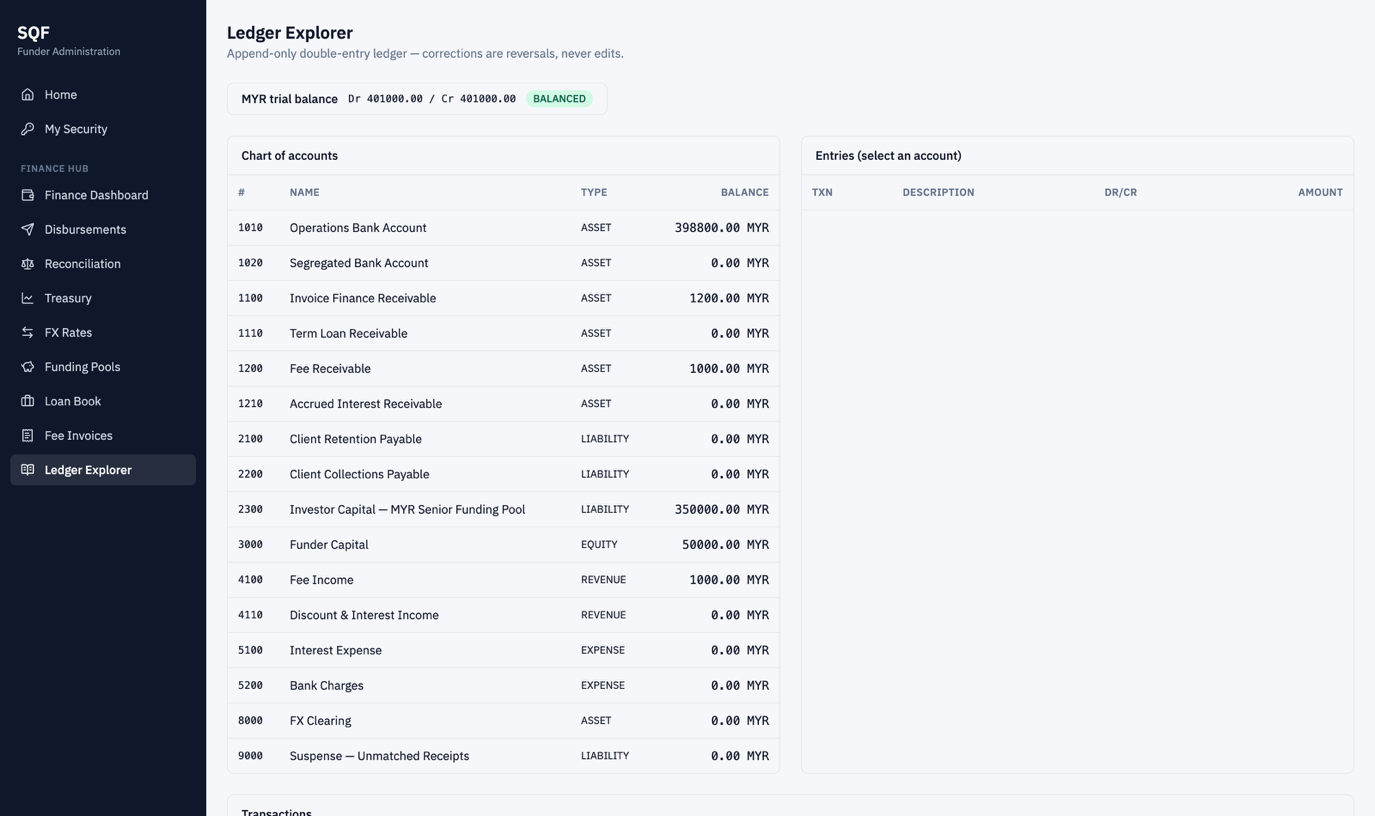
A double-entry general ledger underneath everything the platform does with money.
- Every movement of money is recorded twice — where it came from, and where it went. The two sides must balance, per currency, or the system refuses the entry.
- Amounts are held as whole cents in exact integer arithmetic — no rounding drift, ever.
- Nothing is edited or deleted. A mistake is corrected by a reversing entry, so the full history stays on the record for any audit.
- A trial balance re-proves the whole book at any moment — you can watch it balance on screen.
Simple example: we advance RM 8,000 to a client. The ledger writes Bank −8,000 and Receivable +8,000 in one transaction. If any posting doesn’t balance to the cent, it is rejected outright.
Money out
Payments — four eyes on every payment
Money leaves only through one controlled chain, from request to bank confirmation. Your client has a RM 10,000 invoice approved at an 80% advance rate — here is the whole journey.
- 01
A drawdown is requested
The operations team requests funding against the approved invoice — RM 8,000 lands in the Disbursements queue.
- 02
A finance analyst prepares the voucher
Beneficiary, amount and bank details are frozen into a payment voucher. The preparer's name is on it.
- 03
A finance manager approves
A different person approves with a fresh 6-digit authenticator code. Above your threshold, a second manager must also approve.
- 04
The ISO 20022 file goes to the bank
The global standard payment format. The bank's acceptance or rejection is tracked per payment — a rejection reopens the request; nothing is posted, nothing is lost.
- 05
Settlement posts automatically
Bank −8,000 · Receivable +8,000 · the invoice is marked financed everywhere, in one transaction.
- 06
Fees are billed from the agreed offer
The processing fee is invoiced the moment money moves — from the accepted offer's terms, never re-keyed.
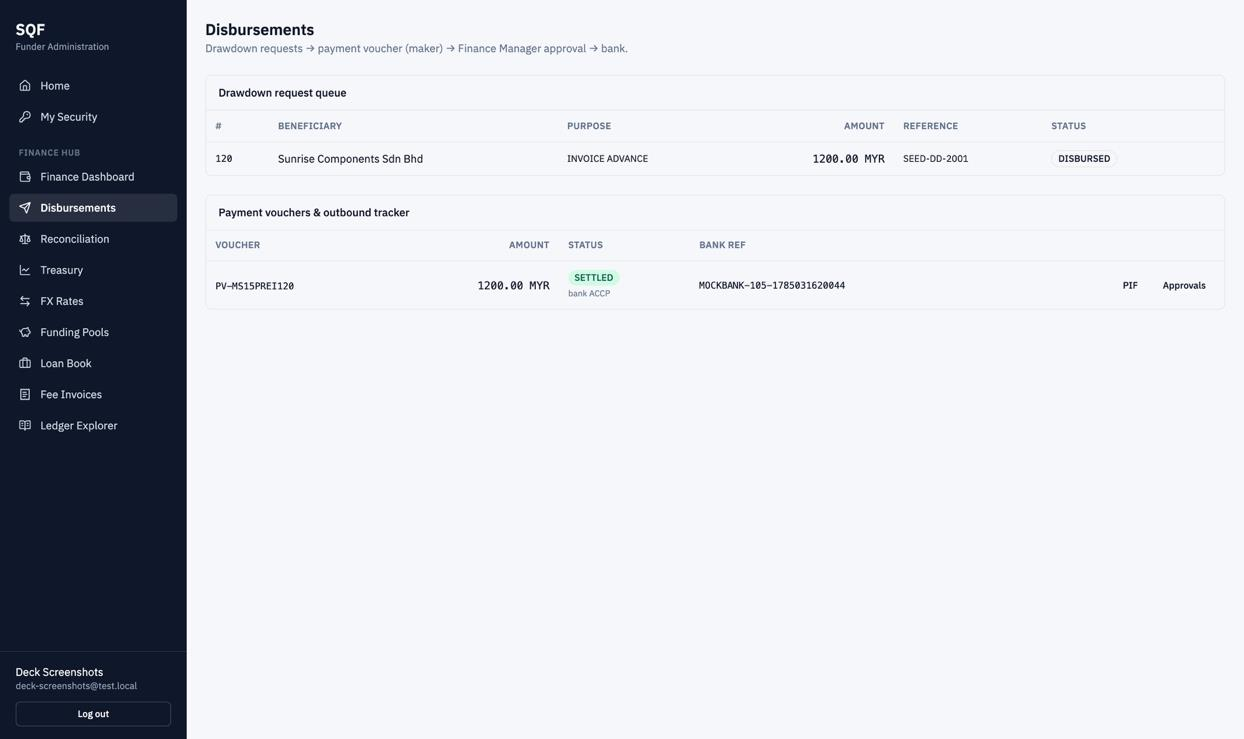
The person who prepares a payment can never approve it — the system enforces this, even for administrators. Larger payments automatically need more approvers, at thresholds you set. Each approval requires a fresh authenticator code, so a stolen password alone cannot release money.
Money in
Collections & reconciliation
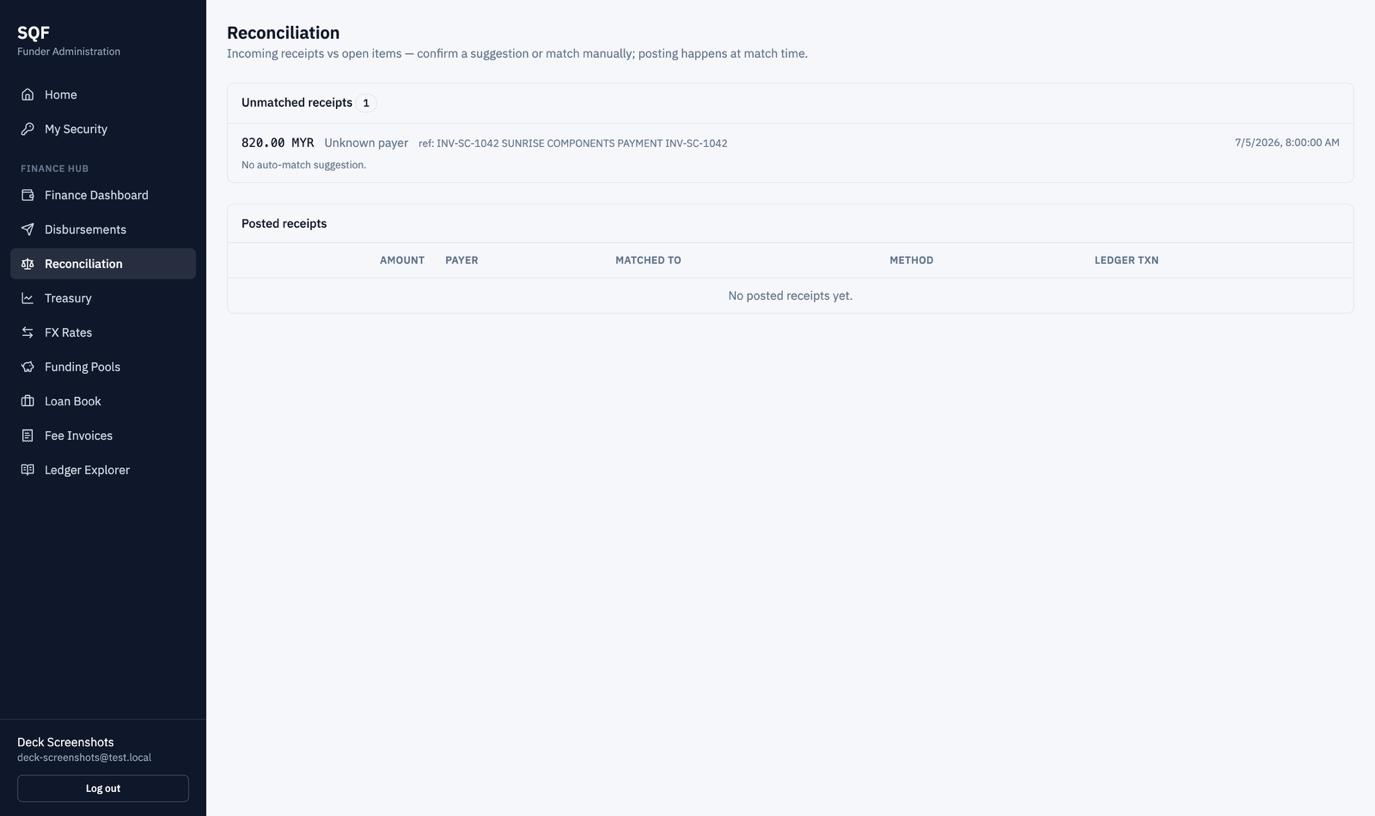
Cash is only booked when it is matched to what it pays for.
- Every client and investor gets a virtual collection account of its own under your master account — a receipt that lands on it attributes itself, and an invoice that names any other account is refused before it can be funded.
- Receipts are recorded directly, or imported straight from your bank statements (MT940) — statement files are checked to the cent before anything is accepted.
- The system suggests matches automatically — by invoice number and exact amount — with a confidence level on each suggestion.
- A person confirms every match. Only matched money posts to the books.
- Unmatched cash stays visible in a suspense queue — never guessed at, never lost.
- When a client’s payment settles their invoice, the invoice is marked paid everywhere, automatically.
Position
Treasury — your cash position at a glance
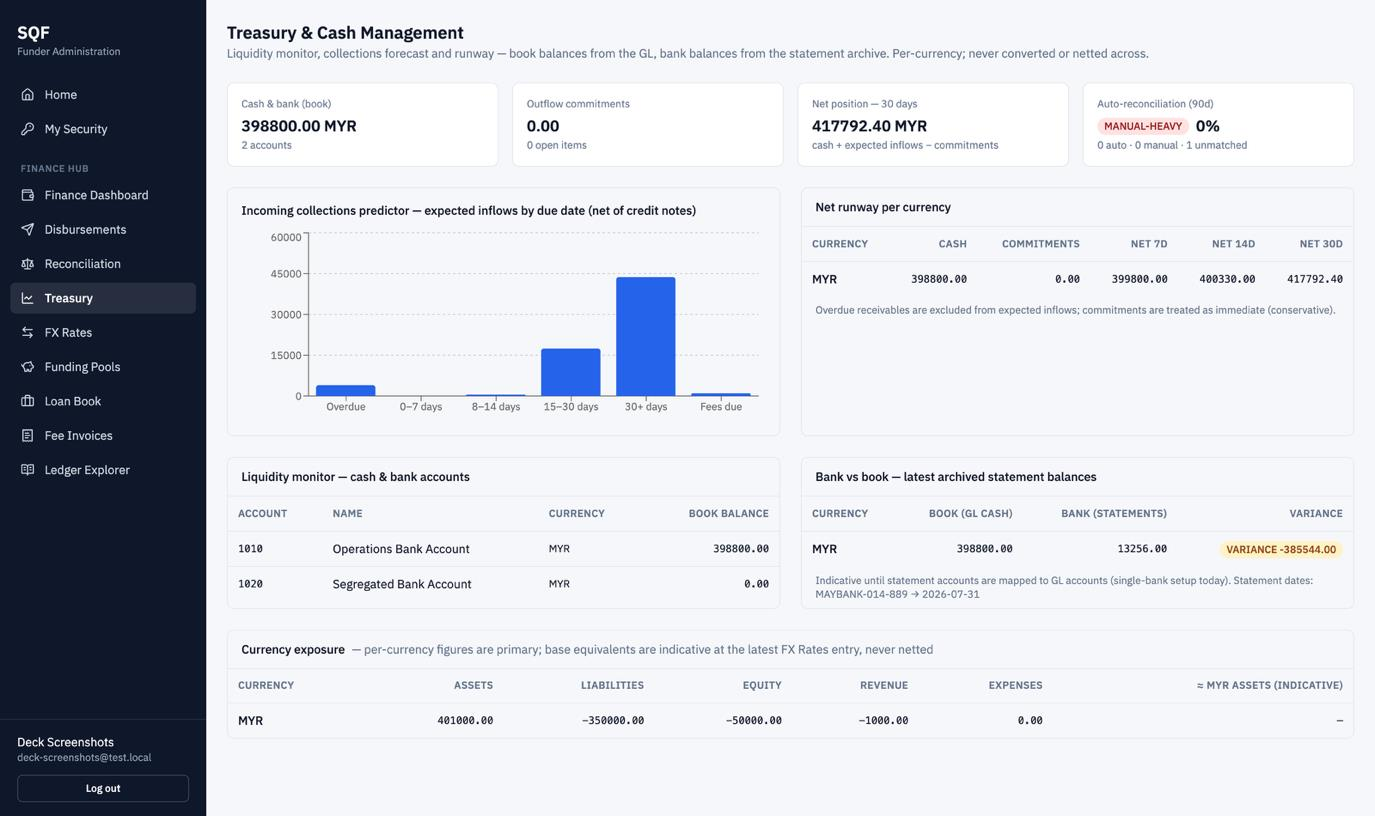
One screen answers: how much cash, what is coming, what is committed, how long it lasts.
- Live cash by bank account, straight from the ledger — checked against your real archived bank statements, bank-vs-book.
- Collections predictor: expected inflows by due date, net of credit notes.
- Committed outflows: every approved-but-unpaid voucher counted, nothing double-counted.
- Cash runway at 7 / 14 / 30 days — deliberately conservative: overdue receivables are excluded, commitments are treated as due now.
- A reconciliation health meter shows how much of your cash flow matches itself without manual work.
Multi-currency
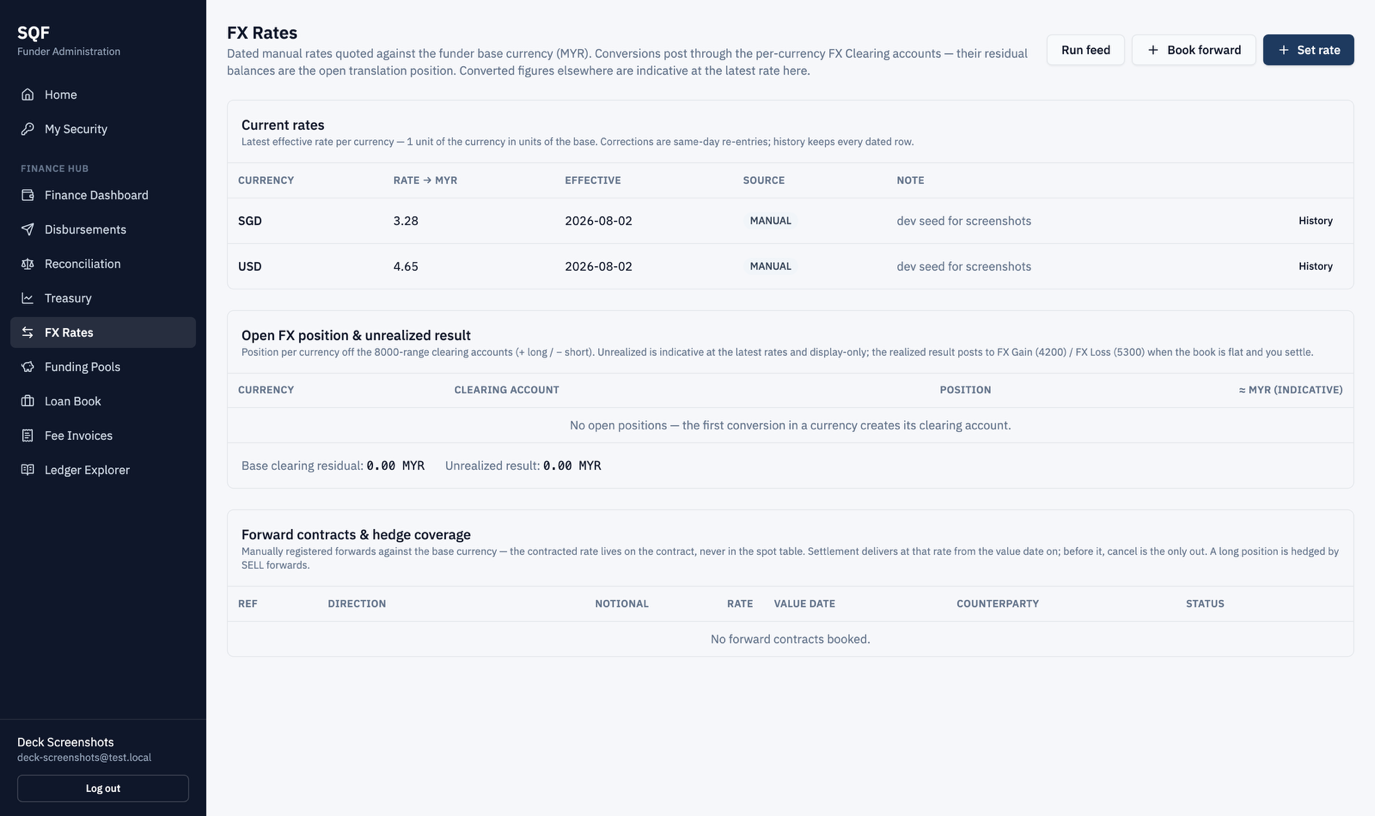
FX, handled honestly
Rates you control, conversions that show their profit and loss, hedging on the record.
- Exchange rates are dated entries you control — or pulled daily from the European Central Bank’s reference feed. Your manual entry always wins for the day.
- A conversion posts through dedicated clearing accounts, so your open currency position is always readable straight off the books.
- When a position is closed out, the realised gain or loss is swept to its own income line — FX profit is never buried.
- Forward contracts can be registered to hedge, and delivered at the contracted rate — in full or in partial drawdowns.
- Dashboards show indicative conversions at the latest rate — and say so; currencies with no rate are named, never silently dropped.
Capital
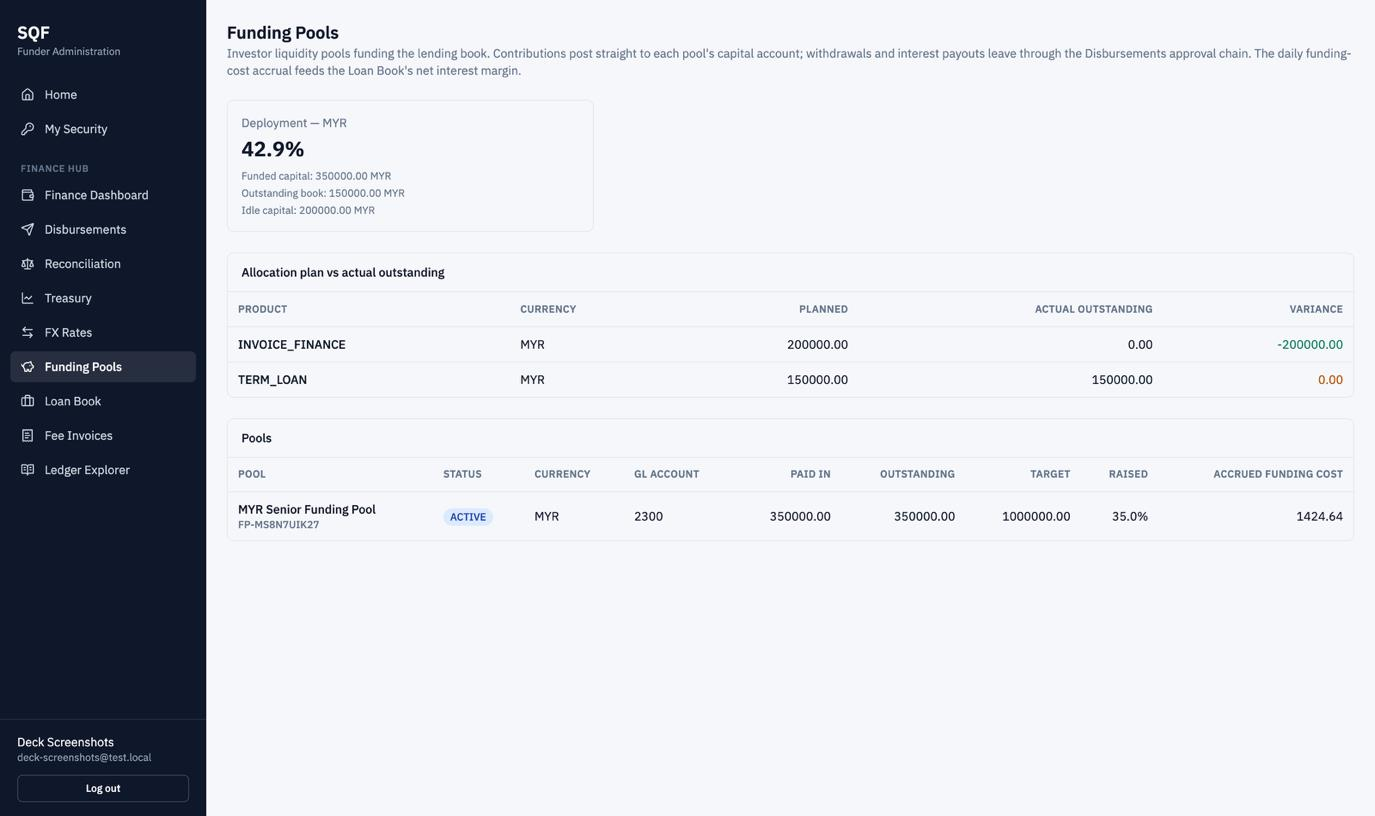
Funding pools — investor capital, ring-fenced
Who funded you, what it costs, and where it is deployed — down to the day.
- Each pool gets its own capital account on the ledger — investor money is visible on the books from the moment it arrives.
- Every contribution is recorded at its agreed fixed rate, on its date.
- Withdrawals and interest payouts leave through the same approval chain as any other payment. No side doors.
- An allocation plan per product is compared against the actual outstanding book — deployment versus intention.
- The daily cost of investor capital is accrued automatically and netted against your lending yield — your true net interest margin, not a guess.
- Structured notes are authored in the product configurator and issued as pools of their own; investors subscribe through the investor portal, in the note’s currency, on a per-currency operations account.
- At maturity a payout desk groups every position’s principal and interest, or credits an investor’s own wallet account when that was their instruction — and every payment still leaves through the four-eyes chain.
Simple example: an investor places RM 250,000 at 6.5% p.a. That costs RM 44.52 a day — accrued daily and subtracted from portfolio yield to show your real margin.
Guardrails
The guardrails, everywhere
The same six protections run through every feature on this page.
Four eyes, enforced
Append-only history
Balanced by construction
Fails safe
Permissions you control
Nothing double-posts
395
Proven, not promised — 395 automated end-to-end checks across the ten finance test suites.
Real database, real messaging, real bank-format files — never mocks. Every worked example on this page — the approvals, the postings, the refusals — is asserted by a test that runs after every change. If a control ever broke, the build would fail before it reached you.
Every ringgit accounted for. Every action approved. Everything on the record.
Every screen on this page is the real system on demonstration data — ask to see it live.